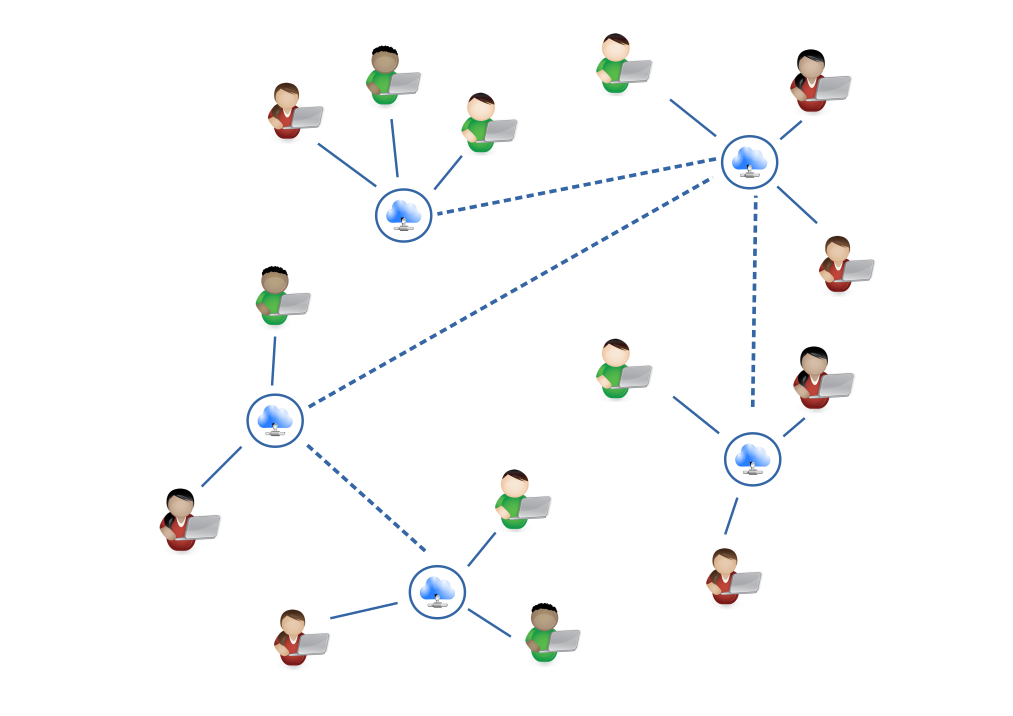
Enable large organisations to scale Nextcloud beyond the typical limitations. As part of Global Scale we will also work on Cloud Federation 2.0, based on the Open Cloud Mesh specification Read more...
With Nextcloud 11 we continue to work on one of our hot topics: Cloud Federation. This time we focus on the social aspects. We want to make it as easy as possible for people to share their contact information. This enabled users to find each other and to start sharing. Therefore we extended the user profile in the personal settings. As the screenshot at the top shows, users can now add a wide range of information to their personal settings and define the visibility for each of them by clicking on the small icon next to it.
Read more...Keynote at the Open16 on how Nextcloud can help to restore a free, decentralized and open Internet. Read more...
Creating public links and sending them to your friends is a widely used feature of Nextcloud. If the recipient of a public link also has a Nextcloud or ownCloud account he can use the “Add to your Nextcloud” button to mount the content over WebDAV to his server. On a technical level all mounted public links use the same token, the one of the public link, to reference the shared file. This means that as soon as the owner removes the public link all mounts will disappear as well. Additionally, the permissions for public links are limited compared to normal shares, public links can only be shared read-only or read-write. This was the first generation of federated sharing which we introduced back in 2014.
Read more...I’m now working for about two years on something called Federated Cloud Sharing. It started on June, 23er 2014 with the release of ownCloud 7.0. Back then it was simply called “Server to Server sharing”. During all this years I never wrote about the broader ideas behind this technology, why we do it, what we achieved and where we are going.
The Internet started as a decentralized network, meant to be resilient to disruptions, both due to accidents or malicious activity. This was one of the key factors which made the Internet successful. From the World Wide Web, over IRC, news groups, e-mail to XMPP. Everything was designed as decentralized networks, which is why if you are on the Google servers you can email people at Yahoo. Everybody can set up his own web server, e-mail or chat server and communicate with everyone else. Individuals up to large organisations could easily join the network, participate and build business without barriers. People could experiment with new innovative ideas and nobody had the power to stop them or to slow them down. This was only possible because all underlying technology and protocols were build on both Open Standards and Free Software.
Read more...Privacy, control and freedom was always one of the main reasons to run your own cloud instead of storing your data on a proprietary and centralized service. Only if you run your own cloud service you know exactly where your data is stored and who can access it. You are in control of your data. But this also introduces a new challenge. If everyone runs his own cloud service it become inevitable harder to share pictures with your friends or to work together on a document. That’s the reason why we at ownCloud are working at a feature called Federated Cloud Sharing. The aim of Federated Cloud Sharing is to close this gap by allowing people to connect their clouds and easily share data across different ownCloud installations. For the user it should make no difference whether the recipient is on the same server or not.
Read more...The last few weeks there has been a lot of rumors about GitHub. GitHub is a code hosting platform which tries to make it as easy as possible to develop software and collaborate with people. The main achievement from GitHub is probably to moved the social part of software development to a complete new level. As more and more Free Software initiatives started using GitHub it became really easy to contribute a bug fix or a new feature to the 3rd party library or application you use. With a few clicks you can create a fork, add your changes and send them back to the original project as a pull request. You don’t need to create a new account, don’t need to learn the tools used by the project, etc. Everybody is on the same platform and you can contribute immediately. In many cases this improves the collaboration between projects a lot. Also the ability to mention the developer of other projects easily in your pull request or issue improved the social interactions between developers and makes collaboration across different projects the default.
Read more...